In 2026, finding a rental home in Hawaii that does not exhaust your monthly budget remains a primary challenge for local families. As private market rental rates across the islands continue to rise, more than 60% of Hawaii families are classified as housing cost-burdened—meaning they pay significantly more than the federally recommended 30% of their gross income toward rent and utilities.
For many working households, essential workers, and kupuna, this financial gap makes staying in the islands they call home feel increasingly uncertain.
Securing housing should not mean choosing between paying rent or buying groceries and essential medications. Affordable housing rental programs exist to provide a reliable, high-quality alternative, helping local residents find stable homes in well-maintained communities.
At Hawaii Affordable Properties, Inc. (HAPI), we manage over 4,000 apartment units across 33 projects on Oahu, Maui, Kauai, and the Big Island.
As a locally owned housing provider founded in the islands in 1992, we help families navigate the application and compliance process with aloha. This comprehensive guide explores Hawaii’s affordable rental landscape, outlines current 2026 program pricing and eligibility limits, and details a clear roadmap to help you secure your next home.
By the Numbers: A Legacy of Island Service
A property provider’s ability to support local families is best demonstrated by their local experience and operational scale. Since 1992, HAPI has maintained a consistent on-island presence:
- 4,000+ Apartments Statewide: Offering high-quality, stable rental housing options across all major Hawaiian islands.
- 33 Projects Across the Islands: Spanning central urban complexes on Oahu to peaceful senior and family communities on the neighbor islands.
- 30+ Years of Local Stewardship: Dedicated to managing compliance-heavy housing programs and keeping local families rooted in Hawaii.
- 10,000+ Residents Served: Supporting local families, working professionals, and kupuna with responsive on-site property management.
Discover Affordable Housing Opportunities Across Hawaii
Affordable housing does not mean lower construction standards. Our properties are modern, energy-efficient, and fully integrated into desirable residential neighborhoods close to schools, employment centers, public transit, and medical facilities.
Our statewide rental portfolio is designed to accommodate different household needs:
- Family Rental Communities: Featuring spacious two-, three-, and four-bedroom layouts designed for growing families.
- Independent Senior Housing: Restricting occupancy to kupuna aged 62 and older (and 55+ in select locations), featuring physical accessibility designs to help residents age in place comfortably.
- Workforce Housing: Targeting essential workers and middle-income professionals who are priced out of private market rentals but earn too much for traditional low-income subsidies.
Most of our communities are funded through federal and state programs like the Low-Income Housing Tax Credit (LIHTC/Section 42), HUD Section 8, and USDA Rural Development Section 515. These programs structure rents to remain affordable for local households, ensuring that your monthly housing costs do not exceed a safe percentage of your income.
How Rent is Calculated: The Affordability Math
Subsidized rental programs calculate rent as a proportion of a household’s income, rather than fluctuating with market demand.
Under standard HUD and USDA guidelines, your monthly housing expenses are capped at approximately 30% of your adjusted gross monthly income.
The mathematical equation used to determine your target housing cost is:
Target Monthly Rent = Adjusted Monthly Income × 0.30
For example, if a local household brings in a certified adjusted income of $3,800 per month, their capped rent portion is:
$3,800 × 0.30 = $1,140 per month
If you choose a flat-rate LIHTC unit, your rent is set at a stable, capped rate tied to your county’s median income tier (such as the 50% or 60% AMI bracket). These rents remain highly affordable compared to private market averages:
2026 Hawaii Average Rental Cost Comparison
| Apartment Unit Size | Average HAPI Subsidized Rent Range | Average Hawaii Private Market Rent | Estimated Monthly Savings |
|---|---|---|---|
| Studio / 1-Bedroom | $800 – $1,100 | $1,900 – $2,200 | $900 – $1,100 |
| 2-Bedroom Layout | $1,100 – $1,400 | $2,600 – $3,100 | $1,200 – $1,700 |
| 3-Bedroom Layout | $1,300 – $1,600 | $3,200 – $3,800+ | $1,500 – $2,200 |
Rent ranges reflect current 2026 HHFDC baseline calculations adjusted for regional utility allowances. Actual rates vary by county and designated unit income tiers.
To keep monthly budgets predictable, HAPI properties apply a mandatory Utility Allowance deduction to units where residents manage their own utility bills. If you pay electricity directly through Hawaiian Electric (HECO), your base monthly rent invoice is reduced to help balance out those energy costs.
Who Qualifies? 2026 Income and Asset Limits
To qualify for placement in an income-restricted community, your household’s total gross annual earnings must fall below specific limits indexed to your county’s Area Median Income (AMI).
2026 Area Median Income (AMI) Thresholds (Family of 4)
| County Jurisdiction | 30% AMI Limit (Extremely Low) | 50% AMI Limit (Very Low) | 60% AMI Limit (Workforce Tier) |
|---|---|---|---|
| Honolulu County (Oahu) | ~$40,380 | ~$66,500 | ~$79,800 |
| Maui County | ~$38,100 | ~$62,100 | ~$74,520 |
| Kauai County | ~$37,050 | ~$61,200 | ~$73,440 |
| Hawaii County (Big Island) | ~$34,290 | ~$56,500 | ~$67,800 |
Data metrics reflect active 2026 HUD and HHFDC indexing. To check your specific household size against county limits, use the HAPI AMI Eligibility Checker.
Important Income Rules Under HOTMA Guidelines
Under active HOTMA (Housing Opportunity Through Modernization Act) federal guidelines, compliance managers must verify all recurring sources of income before taxes.
- Household Income: Includes wages, salaries, tips, Social Security, child support, alimony, pension payments, and self-employment records for every adult occupant (18+) in the unit.
- The Asset Limit Rule: Households with more than $100,000 in certified net liquid assets (excluding standard retirement accounts or approved trusts) are legally excluded from participating in subsidized housing programs.
The 4-Step Application and Placement Process
Applying for an affordable apartment does not have to be an intimidating process. At HAPI, we have streamlined our onboarding path to help you transition from your initial inquiry to moving in as efficiently as possible:
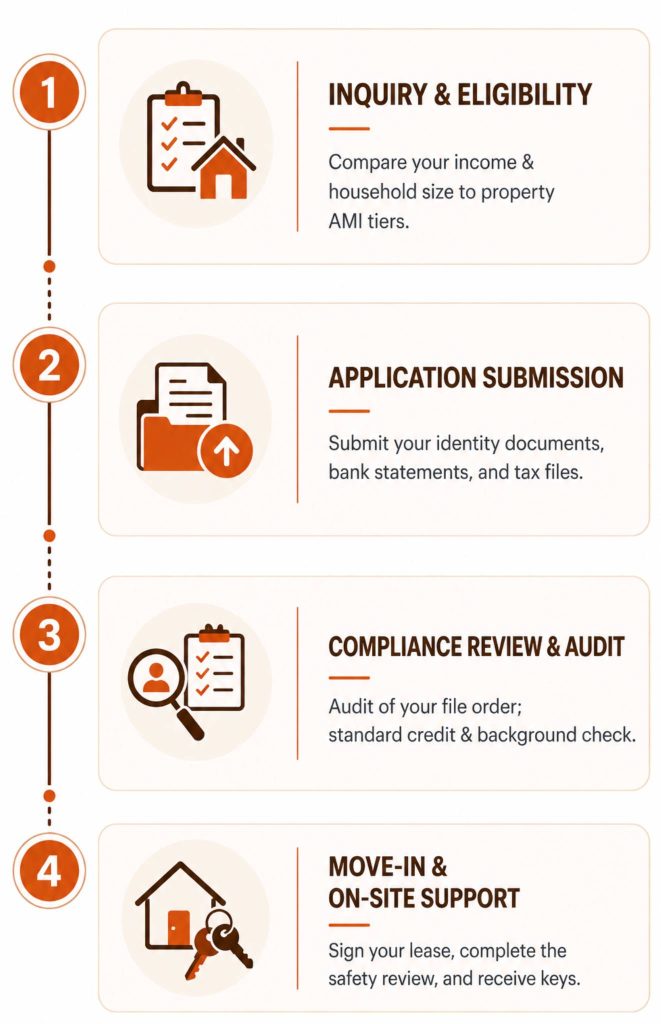
- Inquiry & Eligibility: Browse our active property listings by island and compare your household size and gross income against the designated AMI limits.
- Application Submission: Complete your intake packet and attach your verified records, including pay stubs, photo IDs, Social Security cards, and tax transcripts.
- Review & Approval: Our compliance specialists verify your income, calculate your rent portion, and execute standard tenant screenings. Ninety percent of applicants who submit complete documentation are approved within 30 days.
- Move-In & Support: When a unit becomes available, we coordinate your move-in safety inspection, finalize your lease signing, and introduce you to your on-site manager.
While state-managed public housing waitlists can take up to five years, HAPI’s average placement timelines range between 6 and 18 months because we coordinate vacancies across 33 properties simultaneously, providing a much faster path to a secure home.
Plan your upcoming relocation budget and estimate upfront moving costs with the HAPI Paycheck Pacer Tool.
Real Stories: How Stable Housing Impacts Local Families
- Hilo Resident: “After spending three years on the mainland due to high costs, affordable housing finally allowed us to move back home to raise our children close to their grandparents. We are paying $1,100 per month for our family apartment instead of the $2,400 we were looking at on the open market. That monthly difference changed everything for our family.”
- Property Investor: “HAPI’s deep compliance expertise saved our portfolio from severe administrative penalties. They handle all the annual tenant file reviews, state agency reporting, and housing authority audits perfectly, allowing us to focus on our investment returns. Partnering with them was the best decision we made.”
- Kona Resident: “The on-site maintenance team fixed our water heater the exact same day we submitted the request. After years of dealing with unresponsive private landlords, it is a massive relief to live in a community managed by local experts who actually care about our family’s safety.”
Frequently Asked Questions (FAQ)
How do I know if I qualify for affordable housing?
Eligibility is determined by your gross annual household income relative to the Area Median Income (AMI) set for your island county. Most HAPI properties serve families and individuals earning between 30% and 60% of AMI. Check our individual property pages or contact our leasing office for exact, up-to-date limits matching your household size.
What utility costs are included in my monthly rent?
In almost all of our properties, water, sewer tracking, and trash collection are included in your base rent. In units where you are responsible for managing your own HECO electricity account, we apply a monthly Utility Allowance deduction to reduce your rent invoice and keep your total housing expenses affordable.
What physical safety standards apply to these rentals?
To guarantee healthy, high-quality living conditions, all our properties undergo regular physical evaluations under HUD’s updated NSPIRE (National Standards for the Physical Inspection of Real Estate) guidelines. These standards prioritize active life-safety systems, including functional 10-year sealed smoke alarms and GFCI safety outlets near all water sources.
Partner with an On-Island Management Team You Can Trust
Where you choose to rent is just as important as your eligibility status. Mainland-based property management companies often operate remotely using automated systems that overlook the unique challenges of island living, from regional humidity to local maintenance needs.
HAPI is 100% locally owned and operated. Since 1992, we have managed over 4,000 apartments across 33 projects statewide, utilizing specialized tracking tools from Spectrum Enterprises to process all tenant files and annual recertifications perfectly. Our on-island offices provide responsive property maintenance and face-to-face tenant support, helping you navigate the system with confidence.
Take Your Next Step Toward Housing Security
You have worked hard to build your life in Hawaii, and your family deserves a safe, high-quality home with rent costs that leave room in your budget for daily necessities. Don’t spend another year struggling with market-rate rents that consume your entire paycheck. Explore our statewide listings, organize your documentation, and take your next step toward stable housing today.