Table of content
- Section 8 Rent Calculator & Affordable Housing Rent Estimator
- Understand Your Rent Calculation Options
- How to Calculate Rent for Section 8 and Affordable Housing
- 1. Section 8 Housing Choice Voucher (The 30% Rule)
- 2. LIHTC (Section 42) Maximum Rents
- 3. USDA Rural Development 515
- 2026 Income and Rent Limit Estimates
- The “HOTMA” Impact: New Rules for 2026
- Pro-Rated Rent for Partial Months
- Frequently Asked Questions (FAQ)
Accurately calculating tenant rent, subsidy amounts, and compliance requirements is the backbone of stable affordable housing. Hawaii’s housing landscape is governed by complex federal shifts—specifically the 2026 HOTMA (Housing Opportunity Through Modernization Act) updates and the transition to NSPIRE physical standards.
Whether you are a resident on a fixed income or a property owner managing a multi-island portfolio, Hawaii Affordable Properties, Inc. (HAPI) provides the certified expertise needed to ensure every dollar is calculated with precision. Backed by nearly 30 years of experience, we manage over 4,000 units across Oahu, the Big Island, Maui, and Kauai.
Understand Your Rent Calculation Options
Affordable housing rent is not a “one-size-fits-all” figure. A single error in income verification or utility allowance application can trigger compliance violations or tenant disputes. We hold HUD Certification, Tax Credit Certified (TCC) designations, and USDA Rural Development certification to ensure every calculation meets the highest regulatory standards.
Why Accuracy Matters in 2026
- For Tenants: Prevents overpayment and protects you from retroactive rent charges during annual recertifications.
- For Owners: Protects your LIHTC (Low-Income Housing Tax Credit) from recapture and ensures your HAP (Housing Assistance Payment) contracts remain in good standing.
- For Agencies: Simplifies HUD Management and Occupancy Reviews (MORs) by maintaining audit-ready documentation.
How to Calculate Rent for Section 8 and Affordable Housing
Each program utilizes a distinct methodology. Understanding these differences is essential for accurate budgeting and compliance.
1. Section 8 Housing Choice Voucher (The 30% Rule)
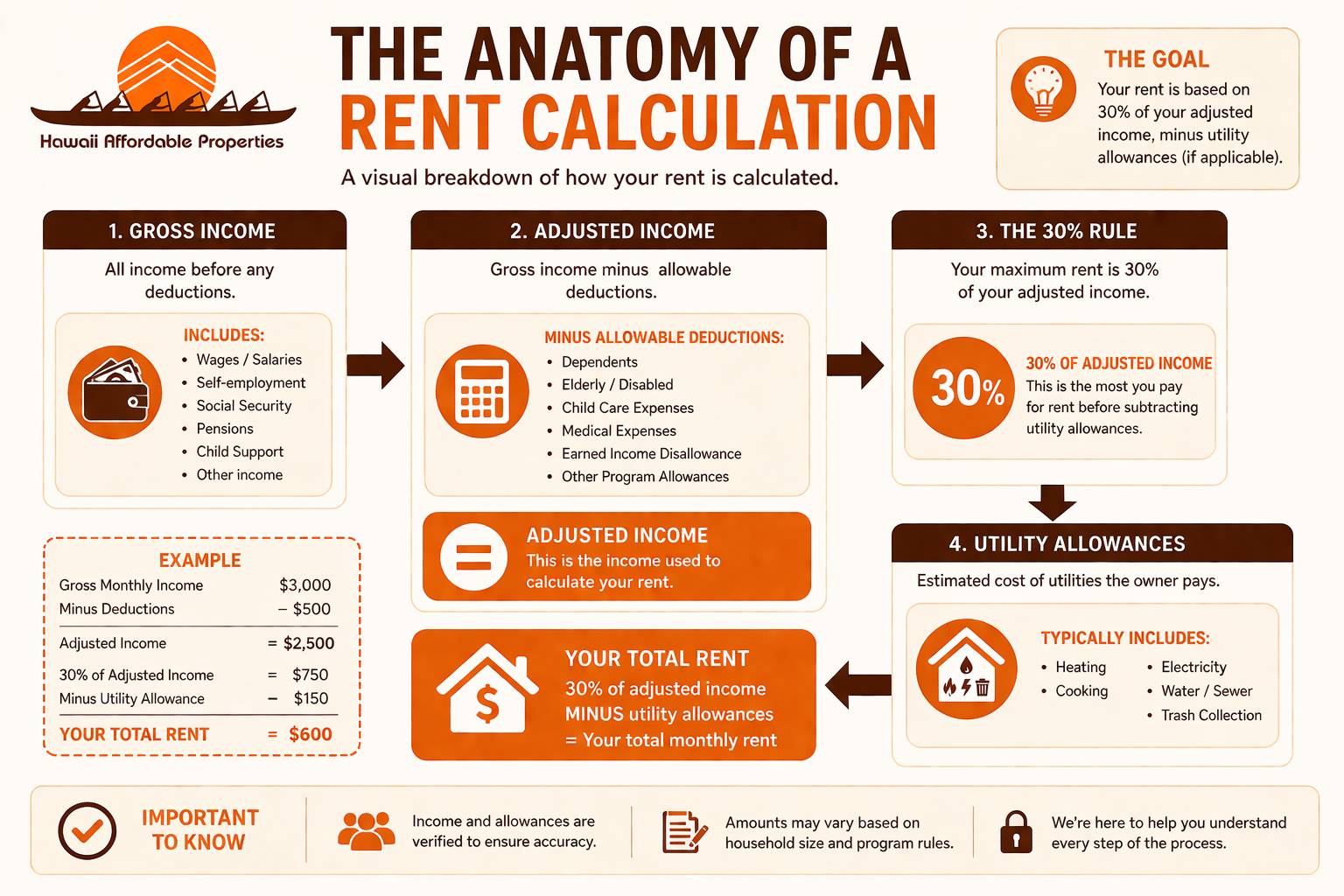
In 2026, Section 8 rent calculations primarily follow the standard HUD formula. Tenants pay roughly 30% of their adjusted monthly income toward rent and utilities.
- Adjusted Income: This is your gross income minus allowable deductions (e.g., $480 per dependent, $400 for elderly/disabled households, and medical expenses exceeding 3% of income).
- Utility Allowances: If you pay your own electricity or water, a Utility Allowance is subtracted from your 30% portion. If your allowance is higher than your rent portion, you may receive a “Utility Reimbursement.”
2. LIHTC (Section 42) Maximum Rents
Unlike Section 8, LIHTC rents are fixed based on the unit’s Area Median Income (AMI) tier (e.g., 30%, 50%, or 60%). The rent does not change if your income fluctuates, as long as you remain below the initial eligibility cap.
3. USDA Rural Development 515
Common in rural areas of the Big Island and Kauai, these programs use a “Basic Rent” vs. “Note Rate Rent” system. If you receive Rental Assistance (RA), you pay 30% of your income; otherwise, you pay the Basic Rent set for the property.
2026 Income and Rent Limit Estimates
The following table provides projected 2026 thresholds for a four-person household in Honolulu County.
| Program Tier | Income Limit (Family of 4) | Max Gross Rent (Estimated) |
|---|---|---|
| 30% AMI (Extremely Low) | ~$45,600 | ~$1,140 |
| 50% AMI (Very Low) | ~$76,000 | ~$1,900 |
| 60% AMI (Workforce) | ~$91,200 | ~$2,280 |
For island-specific data and your exact family size, use our AMI Eligibility Checker.
The “HOTMA” Impact: New Rules for 2026
As of January 1, 2026, the HOTMA final rule has changed several key calculation factors:
- Asset Limitation: Families with net family assets exceeding $100,000 (adjusted for inflation) or those who own “suitable” real property may now be ineligible for Section 8 and Public Housing.
- Imputed Asset Income: The threshold for calculating “imputed income” from assets has been raised from $5,000 to $50,000.
- Deduction Adjustments: The dependent and elderly/disabled deductions are now adjusted annually for inflation to ensure they keep pace with the cost of living.
Pro-Rated Rent for Partial Months
Move-ins and move-outs rarely happen on the 1st of the month. To calculate pro-rated rent:
- Daily Rate: (Monthly Rent ÷ Number of days in that specific month).
- Occupancy Charge: (Daily Rate × Days of occupancy).
Example: If your rent is $1,550 and you move in on May 24th (8 days of occupancy in a 31-day month):
($1,550 / 31) x 8 = $400.00
Frequently Asked Questions (FAQ)
1. Does the calculator account for the 2026 Honolulu utility allowances?
Yes. Our internal tools incorporate the latest Honolulu Department of Community Services (DCS) schedules, which were updated effective January 1, 2026.
2. What happens if my income goes up mid-year?
Under 2026 HOTMA rules, you generally only need to report increases that exceed 10% of your annual adjusted income, unless your specific housing authority requires more frequent reporting.
3. Is my "net" pay or "gross" pay used for the calculation?
Affordable housing programs almost always use Gross Annual Income (total pay before taxes and deductions).
4. How does a "Payment Standard" affect my Section 8 rent?
If you choose a house where the rent is higher than the PHA’s Payment Standard, you must pay the difference yourself. This is known as the “40% rule”—you cannot pay more than 40% of your income toward rent at initial move-in.
5. Are assets like 401(k)s included in the calculation?
While the value of the 401(k) is an asset, only the actual income (dividends/interest) generated by it is typically counted as income, provided you don’t have access to the full sum without penalty.
Why Choose HAPI for Compliance Expertise?
With a portfolio valued over $300 million, HAPI is more than a management company; we are a compliance shield for owners and a support system for residents. Our subscription to Spectrum Professional Consulting ensures our staff is trained on the very latest HUD and IRS regulations.
HAPI: Locally Owned and Trusted Since 1992.