Table of content
- Affordable Housing Income Limits in Hawaii: A 2026 Comprehensive Guide
- Understanding Affordable Housing Income Limits: How They Work
- The Four Primary Income Brackets
- The Multiplier Effect: Household Size Matters
- 2026 Income Limits by County
- 2026 Household Income Limits (Family of 4)
- How to Calculate If You Qualify: Income Verification
- What Counts as Income?
- What Is Excluded?
- Common Disqualifications & Special Circumstances
- How to Apply for Affordable Housing in Hawaii
- Income Limits vs. Reality: What “Low Income” Actually Means
- Staying Qualified: Recertification and Income Changes
If you are earning $50,000 a year in Hawaii, you likely qualify as “low income” under federal housing programs—even if that figure feels significantly higher than traditional poverty lines. In 2026, affordable housing income limits act as the gatekeepers for rent-restricted apartments, Housing Choice Vouchers, and subsidized senior units across the islands. These thresholds are not static; they vary drastically by county, household size, and specific program type.
Understanding exactly where your household falls on the Area Median Income (AMI) scale is the difference between navigating years of waitlists and securing a stable, high-quality home. At Hawaii Affordable Properties, Inc. (HAPI), we specialize in the management of 33 projects across four islands, ensuring that local residents can navigate these complex federal standards with clarity and confidence.
Understanding Affordable Housing Income Limits: How They Work
Affordable housing income limits are built upon a foundation called Area Median Income (AMI). This is the midpoint household income for a specific geographic area, meaning half of the households in that county earn more, and half earn less. HUD (U.S. Department of Housing and Urban Development) calculates these figures annually, and the 2026 limits reflect the shifting economic realities of Hawaii’s unique market.
The Four Primary Income Brackets
Programs categorize eligibility into four distinct tiers based on the AMI:
- Extremely Low Income (30% AMI): Targeted toward those with the highest need, including many seniors on fixed incomes.
- Very Low Income (50% AMI): The standard threshold for most Section 8 and senior housing programs.
- Low Income (80% AMI): Often referred to as “Workforce Housing,” this captures a large portion of Hawaii’s working professionals.
- Moderate Income (Up to 120% AMI): Occasionally used in specific state-funded “Gap Filler” or middle-market developments.
The Multiplier Effect: Household Size Matters
Qualification thresholds shift significantly based on the number of people living in your home. HUD does not simply double the limit for a two-person household; instead, it applies specific multipliers. A single person typically qualifies at 70% of the four-person limit, while an eight-person household qualifies at 132%. This nuance often catches applicants off guard when they try to estimate their own eligibility without professional guidance.
2026 Income Limits by County
The following table provides the 2026 income limits for a four-person household. Because the median income in Honolulu is much higher than in Hawaii County (Big Island), the “ceiling” to qualify for assistance is considerably higher on Oahu.
2026 Household Income Limits (Family of 4)
| County / Island | 30% AMI (Extremely Low) | 50% AMI (Very Low) | 80% AMI (Low Income) |
|---|---|---|---|
| Honolulu (Oahu) | Below $45,600 | $45,601 – $76,000 | $76,001 – $121,600 |
| Maui County | Below $42,300 | $42,301 – $70,500 | $70,501 – $107,700 |
| Hawaii (Big Island) | Below $38,100 | $38,101 – $63,500 | $63,501 – $96,720 |
| Kauai County | Below $41,200 | $41,201 – $68,700 | $68,701 – $104,200 |
Note: These figures are based on the latest 2026 HUD and HHFDC datasets. For your specific household size, use our AMI Eligibility Checker.
How to Calculate If You Qualify: Income Verification
Calculating your eligibility involves more than just looking at your last paycheck. Qualification is based on your gross annual income—the total amount earned by all adult members of the household before any taxes or deductions are taken out.
What Counts as Income?
- Wages & Salaries: This includes base pay, overtime, tips, and bonuses.
- Social Security & Pensions: The full gross amount before Medicare deductions.
- Child Support & Alimony: Even if payments are inconsistent, they must be documented and counted.
- Asset Income: Under the 2026 HOTMA (Housing Opportunity Through Modernization Act) rules, if your household has more than $50,000 in total assets, the income generated by those assets (or an imputed 2% of the value) is added to your total.
- Military BAH: Basic Allowance for Housing is generally included in your gross income for most affordable programs.
What Is Excluded?
- Earned income from minors (under the age of 18).
- Student financial aid (specifically grants, scholarships, and educational loans).
- One-time “lump sum” payments, such as a life insurance settlement or a one-time inheritance.
Common Disqualifications & Special Circumstances
Even if your income falls within the limits, certain administrative rules can lead to a disqualification.
The “Full-Time Student” Rule
In LIHTC (Tax Credit) properties, a household comprised entirely of full-time students is typically ineligible. This is to ensure that affordable housing serves long-term community members rather than temporary student populations. Exceptions exist for single parents, married couples filing jointly, or those previously in the foster care system.
Asset Limits and “Mixed-Status” Households
While most tax credit properties do not have a hard “asset cap,” senior-specific programs (like HUD Section 202) may. Furthermore, “mixed-status” households—where some members are U.S. citizens and others are not—can often still qualify, but the financial assistance is “pro-rated” based only on the eligible members.
How to Apply for Affordable Housing in Hawaii
- Determine Your AMI Bracket: Use our digital tools to see if you fall into the 30%, 50%, or 60% category.
- Explore the Portfolio: For Residential Properties on Oahu or the Big Island, you must apply directly to each individual property office.
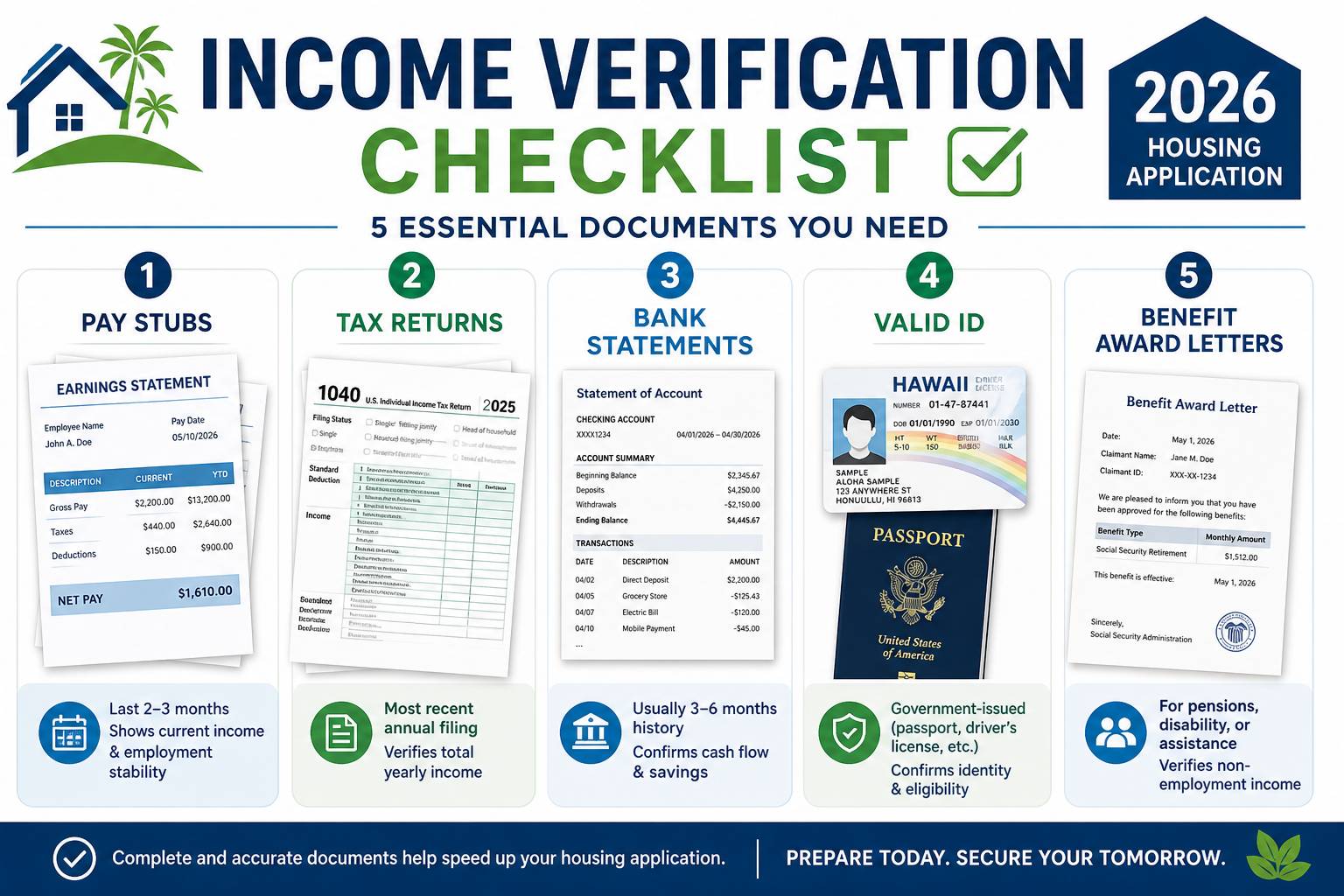
- Prepare a Documentation Binder: In the fast-moving 2026 market, having your 2025 tax returns, two months of pay stubs, and current bank statements ready can put you at the front of the line.
- Join Multiple Lists: Demand is historically high. We recommend applying to at least 3-5 properties to increase your probability of a vacancy notification.
Income Limits vs. Reality: What “Low Income” Actually Means
In 2026, the term “Low Income” in Hawaii is a misnomer. A family of four earning $76,000 in Honolulu is classified as “Very Low Income” by HUD, yet according to current MIT Living Wage and SmartAsset data, that same family requires nearly $290,000 to live “comfortably” (including savings and elective spending) in the islands.
This massive gap proves that affordable housing is not just a social safety net; it is an essential economic tool for the working middle class. These programs are designed for the teachers, paramedics, and service workers who are otherwise priced out of the private market-rate economy.
Staying Qualified: Recertification and Income Changes
Securing a unit is only the first step; maintaining your qualification is an annual requirement.
Annual Recertification
Twelve months after your move-in, you must undergo a recertification process. This mirrors the initial application, requiring updated pay stubs and bank statements to ensure your household still meets program guidelines.
The 140% Rule
If your career flourishes and your income increases, you may wonder if you will be evicted. In most LIHTC properties, the 140% Rule applies: if your income rises above 140% of the current limit, you are allowed to stay, but the property must rent the next available comparable unit to a lower-income tenant to maintain the building’s overall compliance.
Reporting Increases
For Section 8 participants, any income increase of $200 per month or more must be reported to the housing authority within 10 days. Failure to do so can lead to “back-rent” charges or program termination.
Ready to Find Your Home?
Understanding the math behind your eligibility is the most important step toward finding a home you can actually afford. Get guidance on your specific situation today and explore our available units across the islands.
HAPI: Locally Owned and Trusted Since 1992.