Securing a rental property in Hawaii is a significant achievement, but for residents living with physical or mental disabilities, moving into a new home often introduces unique structural or administrative hurdles. A rigid “no-pets” policy can instantly lock out a tenant who relies on an assistance animal, while a first-come, first-served parking setup can create immense challenges for an individual with severe mobility constraints.
Federal and state fair housing laws exist to level the playing field. Under these statutes, housing providers have an affirmative duty to grant Reasonable Accommodations to ensure that individuals with disabilities have an equal opportunity to use, enjoy, and safely occupy their dwellings.
In 2026, local housing authorities and state agencies are closely monitoring fair housing compliance. For renters, knowing how to structure a formal accommodation request is essential to protecting your housing security. For landlords, understanding your obligations under these laws is critical to avoiding costly civil rights violations. This guide breaks down what constitutes a reasonable accommodation, details state-specific rules, and outlines the correct path for executing a request.
Defining Reasonable Accommodations vs. Reasonable Modifications
While they sound similar, housing regulations draw a sharp legal distinction between an accommodation and a modification. Recognizing the difference determines who pays for the adjustment and how the request is processed.
- Reasonable Accommodation: A structural shift, waiver, or exception made to an existing rule, policy, practice, or service. Accommodations cost the landlord nothing administratively but remove a bureaucratic barrier for the tenant. Examples include waving a parking fee for a live-in medical aide or adjusting a rent collection date to align with monthly disability check distributions.
- Reasonable Modification: A physical, structural alteration made to the interior of a rental unit or the common areas of a property. Under standard Low-Income Housing Tax Credit (LIHTC) and private market setups, the tenant bears the cost of the physical installation and removal of the modification. However, if the property receives direct federal funding (such as HUD public housing), the landlord is legally required to pay for the modification unless it creates an undue financial burden.
The Structural Alignment Matrix
| Category / Type | Legal Definition | Financial Responsibility | Common Example |
|---|---|---|---|
| Reasonable Accommodation | Shift in property rules, lease clauses, or policies. | Landlord / Property Manager (Zero cost to implement). | Waiving a “no-pets” rule for a certified Emotional Support Animal (ESA). |
| Reasonable Modification | Physical, structural alteration to the real estate asset. | Tenant (Private/LIHTC) or Landlord (Federally funded properties). | Installing grab bars in a bathroom stall or building a wheelchair ramp. |
Core Examples of Actionable Reasonable Accommodations
Because disabilities vary, there is no single master list of approved accommodations. Every request must be evaluated on a case-by-case basis through a cooperative process between the tenant and management. However, several common scenarios appear regularly across Hawaii’s rental market:
1. Exceptions to “No Pets” Rules for Assistance Animals
This is the most common fair housing issue in Hawaii. Under the Fair Housing Act (FHA), assistance animals are not pets. They are classified as functional medical tools, legally equivalent to a cane or a wheelchair. Assistance animals include task-trained Service Dogs as well as Emotional Support Animals (ESAs) that provide comfort to alleviate symptoms of a psychological disability. Landlords cannot charge pet deposits, pet rent, or implement weight or breed restrictions for verified assistance animals.
2. Assigned Priority Parking Allocations
If a multi-family complex features an unassigned, first-come, first-served parking lot, a tenant with a severe mobility impairment can request an assigned, reserved parking space near their front door. Even if the property charges standard parking fees for premium spots, the fee must be waived if the reserved location is structurally necessary to accommodate the resident’s disability.
3. Adjusting Rent Payment Schedules
If a disabled tenant relies on fixed federal sub-payouts—such as Social Security Disability Insurance (SSDI)—and their checks consistently arrive on the third of the month, they can request a reasonable accommodation to adjust the property’s standard late-fee grace window. Shifting the late fee timeline from the first of the month to the fifth ensures the tenant can pay on time without facing unfair financial penalties.
Who Qualifies under Hawaii and Federal Guidelines?
To legally request an accommodation, the individual must meet the statutory definition of a person with a disability under the FHA and the Hawaii Civil Rights Commission (HCRC) guidelines.
The Three-Part Legal Definition of a Disability
An individual qualifies if they satisfy any of the following parameters:
- They possess a documented physical or mental impairment that substantially limits one or more major life activities (such as walking, seeing, hearing, speaking, learning, or caring for oneself).
- They maintain a verified historical medical record of having such an impairment.
- They are actively regarded by others as having such an impairment.
The Verification Guardrails: What a Landlord Can and Cannot Ask
To protect tenant privacy, HUD and the HCRC enforce strict boundaries regarding what information a landlord can request during the verification process:
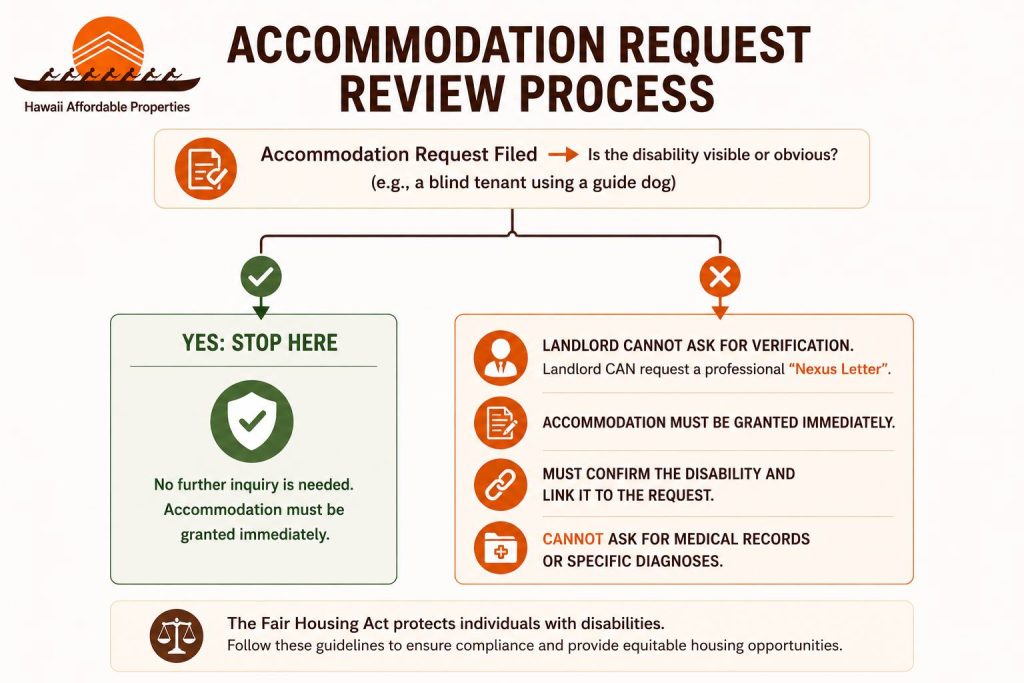
If the disability is hidden or non-obvious (such as chronic PTSD or an internal medical condition), the landlord can request a Nexus Letter from a treating physician, psychiatrist, licensed social worker, or mental health professional. This letter simply verifies that the individual meets the legal definition of a disability and explains how the requested accommodation helps relieve their symptoms. Landlords cannot demand access to your full medical charts or ask intrusive questions about your specific diagnosis.
How to Formally Request an Accommodation in Hawaii
While Hawaii law notes that a reasonable accommodation request can be made verbally, tenants should always submit their requests in writing to establish a clear, dated paper trail.
The Step-by-Step Request Framework
- Step 1: Identify the Connection: Draft a clear letter or email to your property manager or landlord. State explicitly that you are requesting a “Reasonable Accommodation under the Fair Housing Act.”
- Step 2: Detail the Policy Exception: Clearly describe the rule or policy you need modified (e.g., “I am requesting an exception to the building’s pet restriction to accommodate my emotional support animal”).
- Step 3: Attach the Nexus Document: If your disability is not visible, attach your medical professional’s nexus letter to verify the connection between your health needs and the requested policy shift.
- Step 4: Engage in the Interactive Process: Once received, the landlord must respond promptly. Any unreasonable delay or ignore can be legally interpreted as a constructive denial of your rights. Both parties must participate in an “interactive process” to discuss how to implement the accommodation or evaluate reasonable alternatives.
When Can a Landlord Legally Deny a Request?
A housing provider cannot simply reject a request because it is inconvenient or unpopular with other residents. However, under state and federal law, a landlord can legally deny an accommodation request if it meets specific thresholds:
- The Fundamental Alteration Rule: The request requires the property to alter the core nature of its business operations. For example, a tenant cannot request that property staff drive them to medical appointments, as providing personal transit falls outside standard residential property operations.
- The Undue Financial and Administrative Burden Rule: The request forces the owner to incur significant, unrecoverable operational expenses that threaten the financial viability of the asset.
- The Direct Threat Exception: If an assistance animal exhibits documented, aggressive behavior—such as biting a neighbor or damaging property—the accommodation can be revoked. Landlords cannot deny an animal based on generalized breed assumptions, but they can act if the specific animal poses a verified threat to community safety.
Where to Turn for Enforcement and Legal Help
If a landlord refuses to participate in the interactive process, demands illegal pet deposits for an ESA, or threatens eviction following an accommodation request, you can pursue multiple legal avenues for relief:
- State Enforcement: File a formal pre-complaint questionnaire with the Hawaii Civil Rights Commission (HCRC) within 180 days of the incident. The HCRC investigates local housing violations at no cost to the tenant.
- Federal Recourse: Submit an administrative complaint online through HUD’s Office of Fair Housing and Equal Opportunity (FHEO) within one year of the violation.
- Local Legal Assistance: Connect with the Legal Aid Society of Hawaii at (808) 536-4302 to access free or low-cost legal counseling for renters navigating fair housing disputes.
Trust a Property Management Partner Dedicated to Fair Housing
Understanding reasonable accommodation guidelines helps build healthy, respectful, and legally compliant rental relationships. For tenants, these regulations ensure your home supports your health and independence. For property owners, following objective, consistent guidelines protects your investments and provides a welcoming environment for all residents.
At Hawaii Affordable Properties, Inc. (HAPI), fair housing compliance is a foundational part of our daily operations. We manage over 4,000 apartments across 33 projects statewide, utilizing specialized tracking tools from Spectrum Enterprises to process all tenant files, medical verifications, and annual recertifications perfectly. Partnering with a dedicated local team ensures your property operations remain fully compliant with state and federal laws.