For many seniors who have spent their lives working, raising families, and building communities across the Hawaiian Islands, retirement should be a time of peace and security. However, Hawaii’s highly competitive housing market presents a challenging reality for kupuna living on fixed incomes.
With average private market rents on Oahu and the neighbor islands consistently exceeding $2,200 per month, and the average monthly Social Security benefit in Hawaii hovering near $1,650, market-rate rentals can easily consume a senior’s entire budget before they pay for groceries, utilities, or essential medications.
No senior should have to choose between keeping a roof over their head or paying for their healthcare. Affordable senior housing programs exist to protect our kupuna, ensuring they can live independently and comfortably in the communities they call home.
This comprehensive 2026 guide breaks down how affordable senior housing works across the islands, details the pricing and eligibility guidelines for different programs, and outlines HAPI’s straightforward path to securing a home.
What Makes Senior Housing “Affordable” in Hawaii?
In Hawaii’s housing market, “affordable housing” has a specific legal definition. It refers to residential units where housing costs—including rent and estimated basic utilities—are capped at no more than 30% of a household’s adjusted gross monthly income.
The mathematical formula used to determine an income-based senior rent contribution is:
Capped Monthly Senior Rent = Adjusted Monthly Income × 0.30
Under this formula, a kupuna receiving $1,500 per month in Social Security benefits pays approximately $450 per month for rent. A household bringing in $2,400 monthly pays approximately $720 per month. This model ensures that as your fixed income shifts, your housing costs remain proportional and manageable.
As a locally owned housing provider founded in the islands in 1992, Hawaii Affordable Properties, Inc. (HAPI) manages over 4,000 apartments across 33 properties statewide. We specialize in navigating the complex regulatory layers of the six primary programs serving Hawaii seniors, helping families secure placement without the administrative headaches.
2026 Pricing: Understanding the Different Senior Housing Programs
Affordable senior properties utilize different state and federal funding structures. Depending on the building you choose, your rent and residency guidelines will follow one of these primary program frameworks:
1. Low-Income Housing Tax Credit (LIHTC) Properties
The LIHTC (Section 42) program is the largest source of affordable rentals in Hawaii. Rents are set as flat, below-market caps tied to county-specific Area Median Income (AMI) brackets (typically the 50% or 60% AMI tier) rather than fluctuating monthly based on your exact paycheck. This model provides excellent long-term budget predictability for seniors.
2. HUD Section 202 Supportive Housing
Section 202 properties are designed specifically for independent seniors aged 62 and older. Rent is capped strictly at 30% of your adjusted income. These communities feature on-site supportive services, common social areas, and physical accessibility features designed to help kupuna age in place safely.
3. USDA Rural Development (Section 515 & 521)
Designed to support rural communities, USDA Section 515 properties are located primarily on the neighbor islands (the Big Island, Kauai, and rural Maui). When paired with Section 521 Rental Assistance, a senior’s monthly rent contribution is capped at 30% of their adjusted income, with the federal program covering the balance.
Hawaii Senior Housing Program Comparison
| Housing Program | Target Age Group | Monthly Rent Structure | Best Suited For… |
|---|---|---|---|
| HUD Section 202 | 62+ Years of Age | Exactly 30% of adjusted gross income | Seniors requiring supportive community structures |
| LIHTC (Tax Credit) | 55+ or 62+ (Varies) | Flat, below-market capped rent tiers | Active seniors seeking flat-rate budget stability |
| USDA Section 515 | 62+ or Disabled | Exactly 30% of adjusted gross income | Kupuna living in rural neighbor island communities |
| HUD HOME Units | Varies by property | Program-capped affordable flat rates | Seniors looking for long-term rent protections |
Eligibility Requirements: Who Qualifies?
To qualify for placement in an affordable senior community, your household must meet specific age, income, and background guidelines updated for 2026.
1. Age Guidelines
To reside in a senior-designated community (such as HUD Section 202 or USDA senior developments), the primary applicant must be 62 years of age or older at the time of lease signing. Some LIHTC workforce housing communities accommodate active seniors beginning at 55 years of age.
2. 2026 County Income Limits
Eligibility limits are tied to county Area Median Income (AMI) thresholds, which HUD updates annually to reflect local living costs. The table below represents the active 2026 income ceilings for one- and two-person senior households:
2026 Hawaii County-by-County Senior Income Limits
| County Jurisdiction | 50% AMI Limit (1 Person) | 50% AMI Limit (2 People) | 60% AMI Limit (1 Person) | 60% AMI Limit (2 People) |
|---|---|---|---|---|
| Honolulu (Oahu) | ~$46,550 | ~$53,200 | ~$55,860 | ~$63,840 |
| Maui County | ~$42,300 | ~$48,400 | ~$50,760 | ~$58,080 |
| Kauai County | ~$41,200 | ~$47,100 | ~$49,440 | ~$56,520 |
| Hawaii (Big Island) | ~$38,100 | ~$43,500 | ~$45,720 | ~$52,200 |
Data metrics track active 2026 HUD and HHFDC schedules. To check your specific household size against your county’s limits, use the HAPI AMI Eligibility Checker.
3. Income and Asset Rules (HOTMA Compliance)
Under current HOTMA (Housing Opportunity Through Modernization Act) federal guidelines, compliance managers must verify all recurring sources of household income. For seniors, this includes gross Social Security benefits (calculated before Medicare deductions), pensions, annuities, and any part-time wages.
Additionally, standard asset limits apply: households with more than $100,000 in certified net liquid assets (excluding standard retirement accounts or approved trusts) are legally excluded from participating in subsidized housing programs.
The Simple, Respectful Step-by-Step Application Process
At HAPI, we understand that completing government paperwork can feel overwhelming. Our locally based team is here to guide you through every step of the process with patience, clarity, and respect.
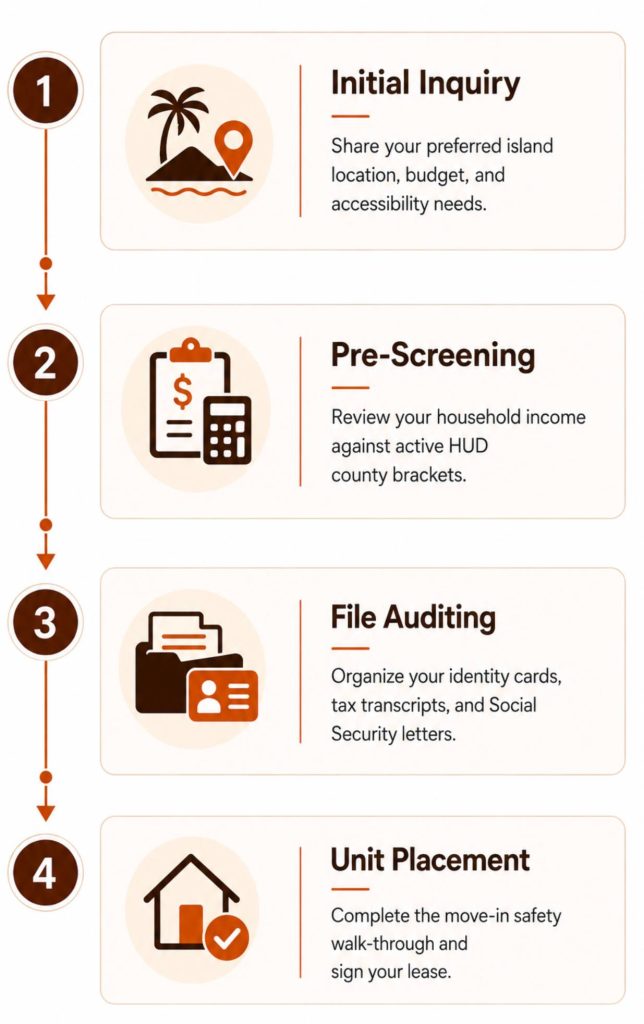
Step 1: Gather Your Document Binder
Organizing your records ahead of time prevents processing delays. Before submitting your application, gather:
- A government-issued photo ID and physical Social Security cards for all household members.
- Your official 2026 Social Security Award Letter showing your gross monthly benefit.
- Three consecutive months of bank statements from all active checking and savings accounts.
- Your most recent federal tax returns (if you are required to file).
- Contact information for your landlords over the past two years to verify rental history.
Step 2: Submit Your Application
Complete your preliminary application online or visit one of our local offices on Oahu or the Big Island. No administrative fees are charged to join a HAPI property waitlist.
Step 3: Waitlist and Move-In Navigation
If no units are immediately available, you will secure a spot on our active, property-specific waitlist. While state-managed public housing waitlists can take up to five years, HAPI’s average placement timelines range from 6 to 18 months because we coordinate vacancies across 33 projects simultaneously.
Estimate your upfront moving costs and plan your relocation savings with the HAPI Paycheck Pacer Tool.
Real Stories: How Affordable Housing Changes Lives
- Oahu Resident: “I didn’t understand the difference between Section 8 and LIHTC, but the HAPI leasing staff explained everything in plain language. Now, my rent is capped at a rate I can actually afford on my Social Security check. I pay $520 per month instead of the $2,100 market rent I was struggling with, and I can finally afford my medications and fresh groceries.”
- Big Island Resident: “I waited 14 months on the HAPI list, but it was worth every single day. The team checked in with me regularly and helped me understand the timeline. Now I’m living independently in Hilo, close to my grandchildren, in a beautiful senior community with zero financial stress.”
- Maui Resident: “After my husband passed away, I couldn’t afford our apartment on my single Social Security check alone. This program saved me from having to leave Maui and move to the mainland. I’m surrounded by wonderful neighbors who understand my journey, and the maintenance team is always quick to help.”
Frequently Asked Questions (FAQ)
What is the most affordable way for a senior to live in Hawaii?
Income-based housing programs (such as HUD Section 202, USDA Section 515, and LIHTC developments) provide the most cost-effective residential options for seniors. By capping housing costs at approximately 30% of your gross monthly income, you can secure a modern, safe apartment for $450 to $850 per month, far below the $2,200+ average for market-rate units.
Does affordable senior housing require a credit check?
Yes. Credit, criminal, and landlord background screenings are standard parts of the application process. However, HAPI’s compliance specialists evaluate your entire situation rather than relying on a single credit score. Past financial hardships, medical debt, or fixed-income challenges are reviewed in context.
Are pets allowed in Hawaii’s active senior communities?
Pet policies vary by property. Many HAPI-managed senior developments accommodate small household pets (under specific weight limits) with a standard security deposit. Under Fair Housing protections, legally certified Service Animals and Emotional Support Animals (ESAs) are fully accommodated in all units with zero pet deposits or monthly fees.
What physical accessibility features are available?
Our properties comply fully with federal ADA accessibility standards, featuring wide entryways, elevator access, wheelchair ramps, and grab bars in bathrooms. Let our leasing team know your specific accessibility needs during your initial inquiry so we can match you with an appropriate unit.
Partner with an On-Island Management Team You Can Trust
Where you choose to rent is just as important as your program eligibility. Mainland-based management companies often operate remotely using automated systems that overlook the unique challenges of island living, from regional humidity to local maintenance needs.
HAPI is 100% locally owned and operated. Since 1992, we have managed over 4,000 apartments across 33 projects statewide, utilizing specialized tracking tools from Spectrum Enterprises to process all tenant files and annual recertifications perfectly. Our on-island offices provide responsive property maintenance and face-to-face tenant support, helping you navigate the system with confidence.
Secure Your Peace of Mind Today
You have spent your life building Hawaii’s communities, and you deserve to enjoy your retirement years in a safe, high-quality, and truly affordable neighborhood. Don’t let rising market rents force you to consider leaving the islands. Connect with our dedicated housing specialists to check your eligibility, explore our property directories, and start your application today.