Table of content
- Who Funds Affordable Housing? Understanding Funding Sources and Asset Management in Hawaii (2026)
- The Funding Landscape: Who Really Pays for the Housing?
- 2026 Comparison of Primary Funding Sources
- Protecting the Revenue Model: Rent vs. Subsidies
- 1. Tenant Contributions & Rental Assistance
- 2. Tax Credit Equity & Incentives
- 3. Long-Term Asset Management
- Visualize Your Portfolio Health
- The Biggest Challenge: Navigating the “Compliance Barrier”
- 2026 Service Tiers: Professional Management Pricing
- Hawaii Management Service Tiers (2026)
- Verify Tenant Eligibility
- Why Choose HAPI for Your Hawaii Portfolio?
- Frequently Asked Questions (FAQ)
- External Resources for Hawaii Owners
In the Hawaii real estate market, “Affordable Housing” is not just a building type—it is a sophisticated financial structure. For nearly 30 years, Hawaii Affordable Properties, Inc. (HAPI) has stood at the center of this ecosystem, managing over 4,000 units across 33 projects statewide.
As we navigate 2026, the complexity of “capital stacking” has reached an all-time high. Whether you are a nonprofit developer, a tax credit investor, or a government housing agency, understanding the flow of capital is essential to protecting your mission and your ROI. In Hawaii, where land and construction costs are among the highest in the nation, affordable housing relies on a delicate balance of federal, state, and private funding.
The Funding Landscape: Who Really Pays for the Housing?
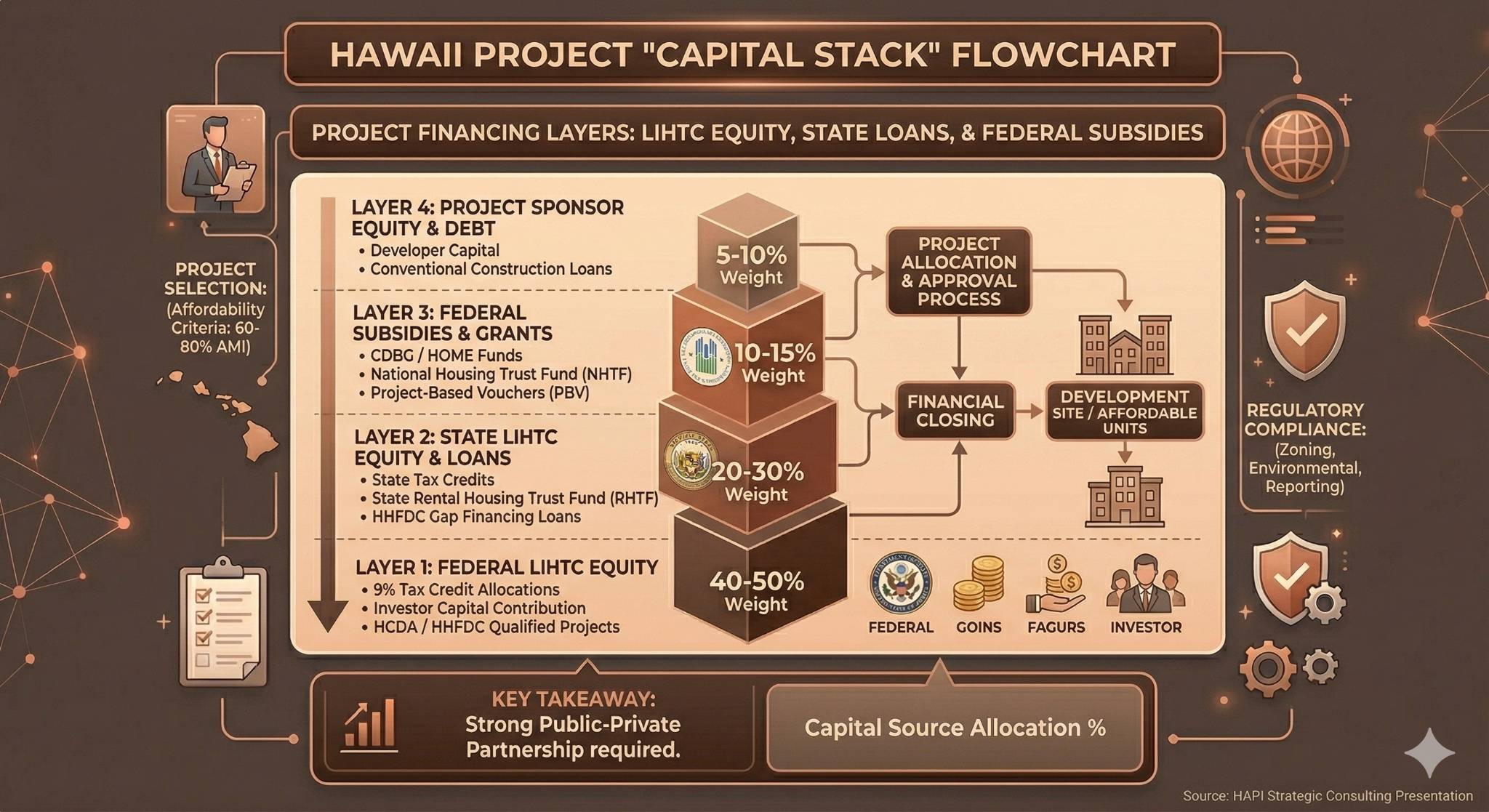
Affordable housing in Hawaii is rarely funded by a single source. Instead, it requires a “layered” approach where different entities cover the gap between what a tenant can afford and the actual cost of development and operation.
2026 Comparison of Primary Funding Sources
| Funding Source | Type of Capital | Primary Requirement | HAPI’s Management Role |
|---|---|---|---|
| Federal (HUD/USDA) | Subsidies/Grants | Strict HQS & Income Limits | HUD-certified compliance & reporting |
| State (HHFDC) | Tax Credits/Loans | LURA Compliance (15-30 years) | Audit-ready file maintenance |
| Private Investors | Equity (LIHTC) | 10-year Tax Credit period | Protecting ROI from IRS recapture |
| Nonprofits | Land/Gap Finance | Mission-aligned social impact | High-quality resident services |
Protecting the Revenue Model: Rent vs. Subsidies
Affordable housing generates revenue through three main channels, each requiring precise management to avoid financial “leakage” or regulatory penalties.
1. Tenant Contributions & Rental Assistance
Residents typically pay 30% of their adjusted gross income. The gap between that payment and the operating cost is covered by Section 8 vouchers or project-based assistance.
2. Tax Credit Equity & Incentives
The Low Income Housing Tax Credit (LIHTC) provides the upfront capital needed to build. However, this capital is contingent on 15–30 years of flawless compliance. If your management team misses an annual recertification, your investors risk tax credit recapture.
3. Long-Term Asset Management
HAPI manages a $300+ million portfolio. We preserve value through preventive maintenance that accounts for Hawaii’s unique environment—saltwater corrosion, termite pressure, and hurricane risks.
Visualize Your Portfolio Health
In 2026, cash flow is king. Even small errors in rent calculation or delays in subsidy requests can impact your debt coverage ratio. Use our visualizer to see how collection efficiency impacts your property’s bottom line.
Try the Late Fee Loss Visualizer
The Biggest Challenge: Navigating the “Compliance Barrier”
The most significant issue with affordable housing funding isn’t just finding the money—it’s keeping it. Each funding source brings its own set of “strings” attached:
- HUD Inspections: Must pass 13 critical areas of Housing Quality Standards.
- USDA 515 Reporting: Requires annual income eligibility determinations.
- LIHTC Certifications: Demands a perfect “paper trail” for every tenant file.
HAPI’s team of 200+ professionals acts as your compliance shield. We subscribe to the Spectrum Professional Tax Credit Consulting Service, ensuring that our staff is trained on the 2026 rules before they even go into effect.
2026 Service Tiers: Professional Management Pricing
We offer three distinct paths for owners and developers, allowing you to choose the level of oversight your portfolio requires.
Hawaii Management Service Tiers (2026)
| Service Tier | Best For… | Key Deliverables |
|---|---|---|
| Full-Service Management | LIHTC & HUD Properties | Complete leasing, 24/7 maintenance, & full compliance |
| Compliance-Only Services | Owners with in-house Ops | Income verifications, annual recerts, & state reporting |
| Consulting & Training | New Developments / Acquisitions | Startup management, audit prep, & staff workshops |
Verify Tenant Eligibility
Are your units filled with the right people? Accurate tenant screening is the first line of defense in funding compliance.
Check AMI Eligibility Now
Why Choose HAPI for Your Hawaii Portfolio?
Founded in 1992, HAPI is a locally-owned company with deep roots in the islands.
- Proven Results: We manage 33 projects valued over $300 million with zero significant compliance violations in our history.
- Certified Expertise: Our staff holds Tax Credit Certified designations, Rural Development credentials, and Hawaii Real Estate Broker licenses.
- Local Responsiveness: With offices on the Big Island and Oahu, and portfolios spanning Maui and Kauai, we provide a hands-on presence that mainland firms cannot match. We understand the specific maintenance needs of Windward vs. Leeward properties.
Frequently Asked Questions (FAQ)
Who really pays for affordable housing in Hawaii?
It is a partnership. Federal programs (HUD, USDA) and state agencies provide the subsidies, while private investors provide equity via LIHTC. The tenants pay a portion of the rent, which is often supplemented by Section 8 vouchers.
How does professional management prevent "recapture"?
Recapture occurs when the IRS takes back tax credits because a unit was found to be out of compliance (e.g., an over-income tenant). HAPI prevents this through a “second-eye” review process where every file is audited internally before the HHFDC ever sees it.
What is the "Funding Gap"?
This is the difference between what it costs to build in Hawaii and the maximum loan a project can support based on its affordable rents. Management helps close this gap by keeping operating expenses (OpEx) low and subsidy collection high.
Can HAPI manage properties on all islands?
Yes. We have a robust statewide infrastructure with dedicated management teams and contractor networks on Oahu, Maui, Kauai, and the Big Island.
How are rents determined in these funded projects?
Rents are set by the most restrictive program funding the unit. This usually means a “capped” rent based on a percentage of the Area Median Income (AMI). We handle the annual recalculations to ensure you are always charging the maximum allowable rent without violating program rules.
Do you offer consulting for new developers?
Yes. We provide “Startup Management” for new developments, helping you navigate the transition from construction to a fully compliant lease-up.
External Resources for Hawaii Owners
Secure Your Investment Today
Whether you are a developer with a new project or an investor looking to shore up your current portfolio, HAPI offers the expertise you need to thrive in 2026.